The Worshipful Company of Gardeners, first mentioned in City Corporation records in 1345, is a survivor from the medieval craft guilds which exercised control over the practice of their particular crafts and ensured a proper training through the system of apprenticeship.
In 1605, after existing for centuries as a mystery or fellowship, the Guild was incorporated by Royal Charter. The Charter sets out the operations controlled by the Company: “The trade, crafte or misterie of gardening, planting, grafting, setting, sowing, cutting, arboring, rocking, mounting, covering, fencing and removing of plants, herbes, seedes, fruites, trees, stocks, setts, and of contryving the conveyances to the same belonging..."
Today, the Company ranks number 66 in the order of precedence of Livery Companies in the City of London.
Coats of Arms
The first known record of the Company’s Coat of Arms is a sketched version on its Royal Charter of 9th November 1616 (see below) and as an emblem on the Company’s Seal.
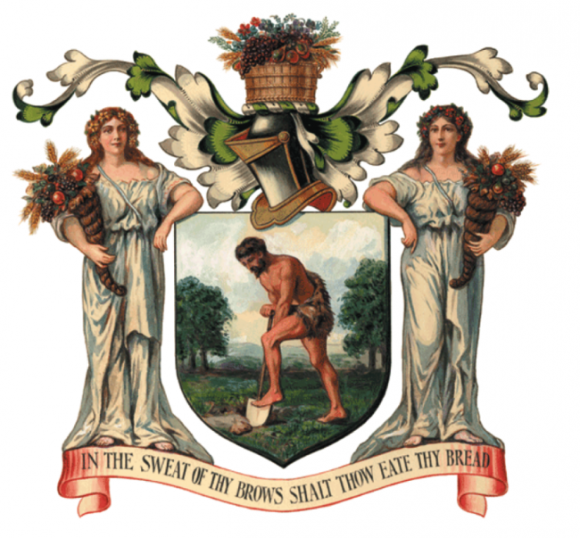
The central shield shows Adam delving in the ground with a spade and the motto below is a quotation from the section of Genesis where the Lord banishes Adam and Eve from the Garden of Eden. The female figures, known in heraldry as Supporters, are holding cornucopias of fruit and flowers, appropriate of course to the gardener's trade.
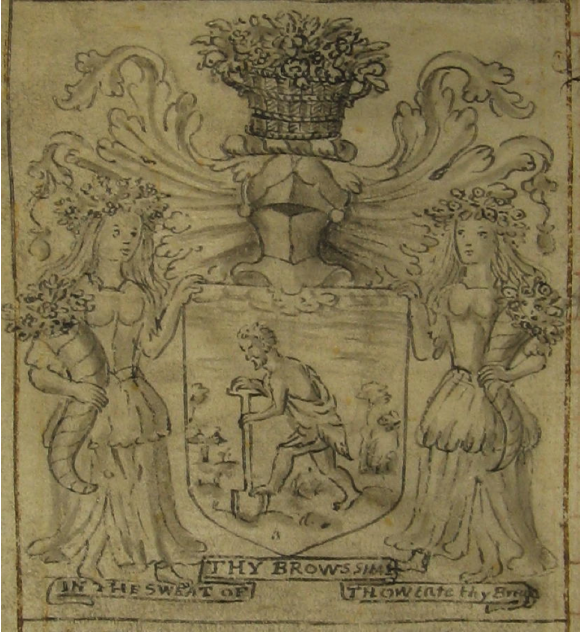
Since then the Coat of Arms has appeared in a number of manifestations, two examples being below.
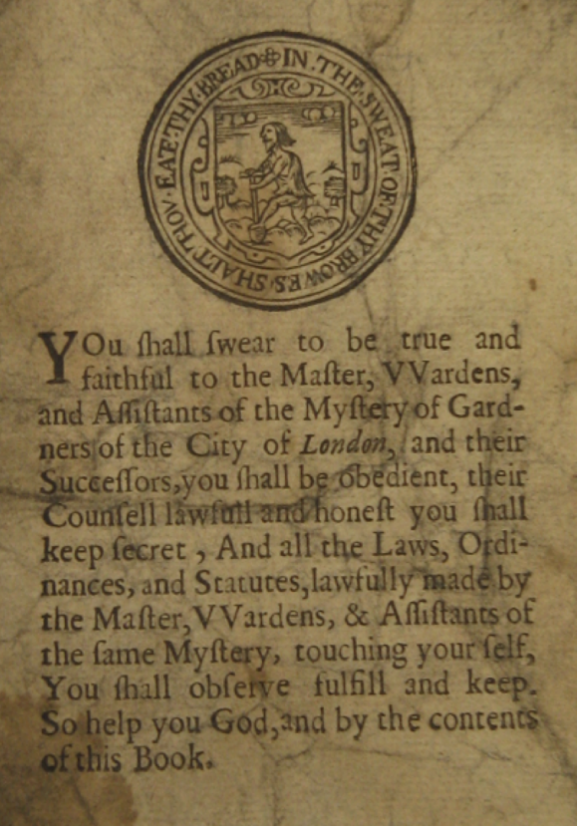
Here the Gardeners' seal, depicting on the central shield another version of Adam vigorously digging, is affixed to a copy of the oath taken by a Freeman on admission to the Company. It dates from about 1650 and, coming from the Commonwealth period, notably excludes a promise of loyalty to the Crown.
Following the formal Grant of Arms by the College of Arms in 1905 the Gardeners' Company has used this version. The Company wanted its website logo to be far simpler and more modern than its Coat of Arms, but is pleased that the website logo has some relationship to this image in terms of both colour and theme.